---
title: The Counterintuitive Lesson of Oil Spikes AI Can Analyze Markets. Can It Fix Human Behavior?
description: Artificial intelligence may analyze markets faster than ever, but it can’t eliminate the human forces that drive volatility. As geopolitical tensions push oil higher and rattle equities, history offers an important reminder for investors navigating uncertainty.
image: https://www.memberswealthllc.com/hubfs/Working%20business%20woman%20with%20global%20reports%20and%20stock%20market%20change%20concept.jpeg
---
[](https://www.memberswealthllc.com/)
# Members' Wealth
[Book a Meeting](https://go.oncehub.com/MeetingwiththeMembersWealthTeam) [Client Login](https://login.orionadvisor.com/login.html?g=60f050c4-32c6-43e3-892a-da37527f25d1&e=4&i=165)
- [Who We Are](https://www.memberswealthllc.com/our-story)
- [How We Help](https://www.memberswealthllc.com/how-we-help)
- [FAQs](https://www.memberswealthllc.com/faqs)
- [Who We Serve](https://www.memberswealthllc.com/who-we-serve)
- [Families](https://www.memberswealthllc.com/who-we-serve/families)
- [Trusts](https://www.memberswealthllc.com/who-we-serve/trusts)
- [Business Owners](https://www.memberswealthllc.com/who-we-serve/business-owners)
- [The R.I.T.E Path](https://www.memberswealthllc.com/insights)
- [Contact Us](https://www.memberswealthllc.com/contact-us)
- [Santa Barbara](https://www.memberswealthllc.com/financial-advisor-santa-barbara-ca)
[Subscribe](https://www.memberswealthllc.com/subscribe)[Client Login](https://login.orionadvisor.com/login.html?g=60f050c4-32c6-43e3-892a-da37527f25d1&e=4&i=165)[Book a Meeting](https://go.oncehub.com/MeetingwiththeMembersWealthTeam)
[Call Us](tel:+1-267-367-5453)
- [Who We Are](https://www.memberswealthllc.com/our-story)
- [How We Help](https://www.memberswealthllc.com/how-we-help)
- [FAQs](https://www.memberswealthllc.com/faqs)
- [Who We Serve](https://www.memberswealthllc.com/who-we-serve)
- [Families](https://www.memberswealthllc.com/who-we-serve/families)
- [Trusts](https://www.memberswealthllc.com/who-we-serve/trusts)
- [Business Owners](https://www.memberswealthllc.com/who-we-serve/business-owners)
- [The R.I.T.E Path](https://www.memberswealthllc.com/insights)
- [Contact Us](https://www.memberswealthllc.com/contact-us)
- [Santa Barbara](https://www.memberswealthllc.com/financial-advisor-santa-barbara-ca)
Our Insights
#### Share this
[Share on X](https://x.com/intent/post?url=https://www.memberswealthllc.com/insights/the-counterintuitive-lesson-of-oil-spikes-ai-can-analyze-markets.-can-it-fix-human-behavior&text=The+Counterintuitive+Lesson+of+Oil+Spikes+AI+Can+Analyze+Markets.+Can+It+Fix+Human+Behavior%3F) [Share on Facebook](https://www.facebook.com/sharer/sharer.php?u=https://www.memberswealthllc.com/insights/the-counterintuitive-lesson-of-oil-spikes-ai-can-analyze-markets.-can-it-fix-human-behavior&t=The+Counterintuitive+Lesson+of+Oil+Spikes+AI+Can+Analyze+Markets.+Can+It+Fix+Human+Behavior%3F) [Share on LinkedIn](https://www.linkedin.com/shareArticle?mini=true&url=https://www.memberswealthllc.com/insights/the-counterintuitive-lesson-of-oil-spikes-ai-can-analyze-markets.-can-it-fix-human-behavior&t=The+Counterintuitive+Lesson+of+Oil+Spikes+AI+Can+Analyze+Markets.+Can+It+Fix+Human+Behavior%3F)
# The Counterintuitive Lesson of Oil Spikes AI Can Analyze Markets. Can It Fix Human Behavior?
by [**Dane Czaplicki**](https://www.memberswealthllc.com/insights/author/dane-czaplicki) on Mar 09, 2026

Artificial Intelligence is supposed to make everything smarter. Markets analyze more data than ever. Algorithms digest earnings calls, geopolitical headlines, shipping traffic, and supply chains in real time.
And yet, here we are again.
A week into military escalation involving Israel, the United States, and Iran, markets are reacting the same way they always have: with uncertainty, volatility, and emotion.
AI may change many things in finance, b ut it hasn’t changed the most important variable.
Humans still run the world.
Humans still make political decisions.
Humans still fight wars.
And markets still react to both.
*The Market Reaction So Far*
Equities had a tough week, the worst in quite some time. Oil prices up approximately 35% (through Friday 3/6/26), the biggest weekly jump since the early 1980s.
And yet the broader market (S&P 500) is still not even 5% off its highs.
That’s an important reminder of something investors often forget in volatile moments.
Normal market behavior often feels worse than it actually is.
Meanwhile, oil prices have moved higher, which brings back a familiar fear — that a geopolitical shock could ripple through the economy and push us toward recession.
Oil spikes matter for a few reasons.
1. Higher energy prices act like a tax on consumers, reducing discretionary spending.
2. Corporate margins can get squeezed, particularly in transportation and manufacturing.
3. Rising energy costs can complicate inflation trends, making life harder for central banks.
4. A sustained energy shock can slow global economic growth.
Those are legitimate risks.
But history sometimes delivers surprising results.
*What the Data Actually Shows*
The chart below (Thanks to “Chart Kid Matt” great name Matt BTW, I left Matts notes below the graph) looks at instances when crude oil rose 5% or more for two consecutive days — a move that usually reflects sudden geopolitical stress or supply disruption.
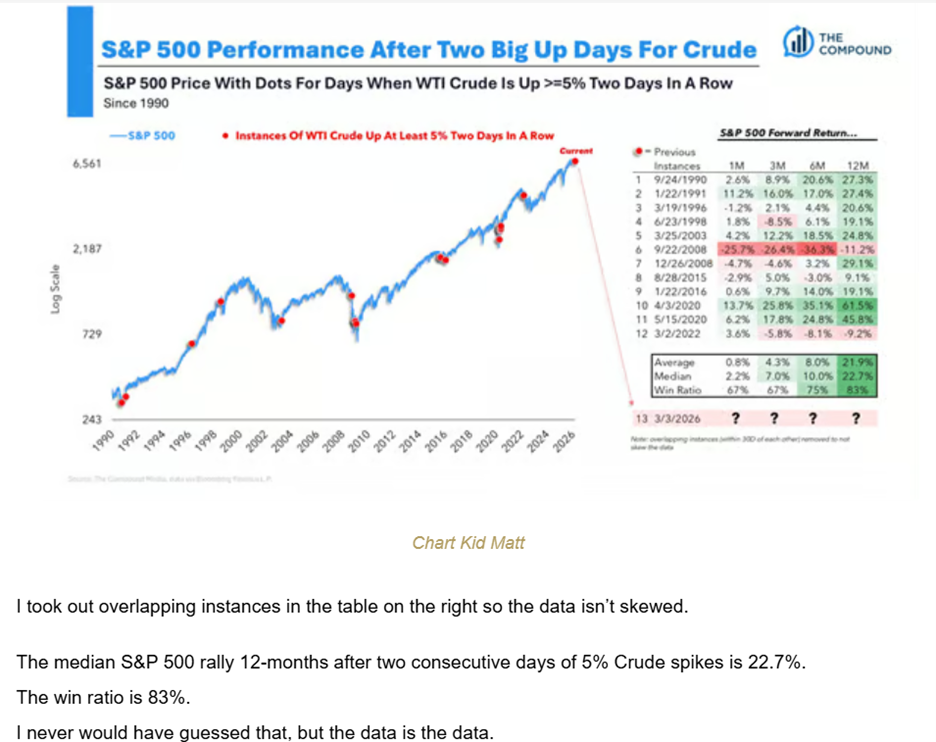
Historically, those moments have felt extremely uncomfortable for investors.
But the data shows something unexpected. The median S&P 500 return twelve months later has been about 22.7%. The market was higher 83% of the time.
Why is this? Oil price spikes rarely last because high prices trigger their own correction: demand slows, strategic reserves are released, producers increase supply, and speculative fear trades unwind once the initial shock passes. In other words, the cure for high oil prices is often high oil prices themselves, as markets eventually rebalance.
Now what about exceptions to self-correction? Exceptions occur when supply is structurally constrained for long periods — such as during the 1973 Arab oil embargo or the 1979 Iranian Revolution — when geopolitical disruptions removed large amounts of production from the market and kept prices elevated for years. This is of course on everyone’s mind currently. Exceptions do occur and when they do, if they do, we believe we are prepared and we will adjust. But in the meantime, we monitor the situation closely, discuss preparedness and our plans for worst case scenarios, but we do not try to predict.
Investing often feels like navigating chaos in real time. But history has a way of reminding us that fear and opportunity frequently arrive together. Now of course, historical patterns do not have to repeat. Each geopolitical event carries its own risks. But the lesson is still worth noting.
Markets often price fear quickly, even when the long-term economic impact ends up being smaller than initially expected.
*While AI May Account for Human Behavior, Does It Matter?*
This brings us back to AI. AI technology can process enormous amounts of data, potentially reducing uncertainty in some regards. But it cannot eliminate uncertainty. Can anything? Is uncertainty ever eliminated or does it just shift? Technology cannot predict with certainty how geopolitical conflicts evolve.
And technology certainly cannot completely remove the emotional swings investors experience when uncertainty rises.
Markets will still overreact.
Investors will still panic.
Headlines will still amplify fear.
Technology changes the tools. It does not change human nature (at least not as fast as technology itself changes).
*What Actually Matters for Investors*
Events like Iranian conflict and rising oil prices remind us why portfolio structure matters more than prediction.
A few principles become especially important during geopolitical stress.
1. Maintain liquidity.
If your portfolio can comfortably fund near-term spending needs, you are far less likely to make emotional decisions during volatility.
2. Avoid leverage.
Leverage is what turns temporary volatility into permanent damage.
3. Own durable businesses.
Companies with strong balance sheets and real earnings tend to survive geopolitical shocks and economic slowdowns.
1,2, and 3 should always apply. Regardless of the environment, if you feel you are not aligned with these three, you may need to revisit your allocations.
*Opportunistic, Not Reactionary*
At moments like this, at Members’ Wealth, we are not making dramatic portfolio shifts based on headlines. But headline volatility can create opportunities.
Currently, some investors may consider rebalancing portfolios after a strong multi-year run in equities, trimming positions that have become overly concentrated, or conversely, gradually adding to high-quality companies if volatility pushes prices lower.
These are not dramatic moves.
They are simply disciplined portfolio management.
*One Opportunity Many Investors Overlook*
Interestingly, geopolitical stress this week has also pushed interest rates modestly higher again. That matters. For much of the past year markets expected interest rates to move steadily lower. Now interest rates have moved higher again. This means the opportunity to lock in longer-term income from high-quality bonds has quietly improved.
Investors often remember to buy stocks when they fall. But they forget to be mindful of other opportunities. When interest rates rise, bond prices fall and yields improve.
For investors who were underweight bonds or waiting for better entry points, environments like this can offer an opportunity to extend duration and lock in attractive yields.
*The CIO Reality* (that’s Chief Investment Officer, not Chief Information Officer)
As a CIO, geopolitical events like this highlight a simple truth.
We cannot predict them.
But we can prepare for them.
Markets will always experience shocks: wars, oil spikes, political uncertainty, financial bubbles, technological revolutions.
Artificial intelligence may transform many industries.
But it will not eliminate volatility.
And that’s okay.
Because long-term investing has never depended on avoiding volatility.
It depends on surviving it.
And continuing to compound through it.
If you would like to review how your portfolio is positioned for geopolitical risks, interest rate shifts, and long-term opportunities, the Members’ Wealth team is always happy to have that conversation.
[Contact us today](https://www.memberswealthllc.com/contact-us).
*Investment strategies, including rebalancing, do not guarantee improved performance and involve risk, including potential loss of principal. Past performance does not guarantee future results.*
*The information provided is for educational and informational purposes only and does not constitute investment advice and it should not be relied on as such. It should not be considered a solicitation to buy or an offer to sell a security. It does not take into account any investor's particular investment objectives, strategies, tax status or investment horizon.
All information has been obtained from sources believed to be reliable, but its accuracy is not guaranteed. There is no representation or warranty as to the current accuracy, reliability or completeness of, nor liability for, decisions based on such information and it should not be relied on as such.*
### **About the Author**
### **Dane Czaplicki, CFA®**
[Dane Czaplicki](https://www.memberswealthllc.com/dane-czaplicki) is CEO of Members’ Wealth, a boutique wealth management firm that offers a comprehensive approach to serving individuals, families, business owners, and institutions. The firm’s goal is to preserve and grow its clients’ wealth to endure over time, while thoughtfully evolving its strategy to suit an ever-changing world. With over 20 years of wealth management experience, Dane and the Members' Wealth team thrive on bringing clarity and confidence to clients' unique situations. He believes everyone needs sound financial advice from someone whose interests are aligned with theirs, and is determined to put service before all else.
Dane received his MBA from The Wharton School of Business at the University of Pennsylvania and his bachelor’s degree from Bloomsburg University. Outside work, he enjoys spending time with his wife and kids, hiking and camping, reading, running, and playing with his dog. To learn more about Dane, connect with him on [LinkedIn](https://www.linkedin.com/in/danecfa/).
To get in touch with the Members’ Wealth team today, I invite you to email [info@memberswealthllc.com](mailto:info@memberswealthllc.com) or call (267) 367-5453.
You can learn more about how we serve our clients by tapping the button below.
[Learn More](https://www.memberswealthllc.com/how-we-help)
*Investment advisory services are offered through Members’ Wealth, LLC., a Registered Investment Advisory Firm.*
*Registration with the SEC does not imply a certain level of skill or training. We are an independent advisory firm helping individuals achieve their financial needs and goals*
*Members’ Wealth does not provide legal, accounting or tax advice. Please consult your tax or legal advisors before taking any action that may have tax consequences.*
*This commentary reflects the personal opinions, viewpoints and analyses of the Members’ Wealth, LLC employees providing such comments, and should not be regarded as a description of advisory services provided by Members’ Wealth, LLC or performance returns of any Members’ Wealth, LLC client. The views reflected in the commentary are subject to change at any time without notice. Nothing in this commentary constitutes investment advice, performance data or any recommendation that any particular security, portfolio of securities, transaction or investment strategy is suitable for any specific person. Any mention of a particular security and related performance data is not a recommendation to buy or sell that security. Members’ Wealth, LLC manages its clients’ accounts using a variety of investment techniques and strategies, which are not necessarily discussed in the commentary. Investments in securities involve the risk of loss. Past performance is no guarantee of future results*
*Copyright © 2023 Members' Wealth LLC*
Topics: [Members' Minute](https://www.memberswealthllc.com/insights/tag/members-minute)
#### Share this
[Share on X](https://x.com/intent/post?url=https://www.memberswealthllc.com/insights/the-counterintuitive-lesson-of-oil-spikes-ai-can-analyze-markets.-can-it-fix-human-behavior&text=The+Counterintuitive+Lesson+of+Oil+Spikes+AI+Can+Analyze+Markets.+Can+It+Fix+Human+Behavior%3F) [Share on Facebook](https://www.facebook.com/sharer/sharer.php?u=https://www.memberswealthllc.com/insights/the-counterintuitive-lesson-of-oil-spikes-ai-can-analyze-markets.-can-it-fix-human-behavior&t=The+Counterintuitive+Lesson+of+Oil+Spikes+AI+Can+Analyze+Markets.+Can+It+Fix+Human+Behavior%3F) [Share on LinkedIn](https://www.linkedin.com/shareArticle?mini=true&url=https://www.memberswealthllc.com/insights/the-counterintuitive-lesson-of-oil-spikes-ai-can-analyze-markets.-can-it-fix-human-behavior&t=The+Counterintuitive+Lesson+of+Oil+Spikes+AI+Can+Analyze+Markets.+Can+It+Fix+Human+Behavior%3F)
- Recent
- Topics
- Archive
Recent
Topics
- [Members' Minute (188)](https://www.memberswealthllc.com/insights/tag/members-minute)
- [Estate Strategy (36)](https://www.memberswealthllc.com/insights/tag/estate-strategy)
- [Wealth Strategy (29)](https://www.memberswealthllc.com/insights/tag/wealth-strategy)
- [Quarterly Update (13)](https://www.memberswealthllc.com/insights/tag/quarterly-update)
- [Fiduciary Education (5)](https://www.memberswealthllc.com/insights/tag/fiduciary-education)
- [Weekender (5)](https://www.memberswealthllc.com/insights/tag/weekender)
See all
Archive
- [October 2026 (2)](https://www.memberswealthllc.com/insights/archive/2026/10)
- [September 2026 (7)](https://www.memberswealthllc.com/insights/archive/2026/09)
- [August 2026 (8)](https://www.memberswealthllc.com/insights/archive/2026/08)
- [July 2026 (8)](https://www.memberswealthllc.com/insights/archive/2026/07)
- [June 2026 (8)](https://www.memberswealthllc.com/insights/archive/2026/06)
- [May 2026 (8)](https://www.memberswealthllc.com/insights/archive/2026/05)
- [April 2026 (3)](https://www.memberswealthllc.com/insights/archive/2026/04)
- [March 2026 (6)](https://www.memberswealthllc.com/insights/archive/2026/03)
- [February 2026 (5)](https://www.memberswealthllc.com/insights/archive/2026/02)
- [January 2026 (6)](https://www.memberswealthllc.com/insights/archive/2026/01)
- [December 2025 (6)](https://www.memberswealthllc.com/insights/archive/2025/12)
- [November 2025 (8)](https://www.memberswealthllc.com/insights/archive/2025/11)
- [October 2025 (10)](https://www.memberswealthllc.com/insights/archive/2025/10)
- [September 2025 (10)](https://www.memberswealthllc.com/insights/archive/2025/09)
- [August 2025 (10)](https://www.memberswealthllc.com/insights/archive/2025/08)
- [July 2025 (14)](https://www.memberswealthllc.com/insights/archive/2025/07)
- [June 2025 (10)](https://www.memberswealthllc.com/insights/archive/2025/06)
- [May 2025 (12)](https://www.memberswealthllc.com/insights/archive/2025/05)
- [April 2025 (11)](https://www.memberswealthllc.com/insights/archive/2025/04)
- [March 2025 (10)](https://www.memberswealthllc.com/insights/archive/2025/03)
- [February 2025 (7)](https://www.memberswealthllc.com/insights/archive/2025/02)
- [January 2025 (9)](https://www.memberswealthllc.com/insights/archive/2025/01)
- [December 2024 (3)](https://www.memberswealthllc.com/insights/archive/2024/12)
- [November 2024 (5)](https://www.memberswealthllc.com/insights/archive/2024/11)
- [October 2024 (6)](https://www.memberswealthllc.com/insights/archive/2024/10)
- [September 2024 (5)](https://www.memberswealthllc.com/insights/archive/2024/09)
- [August 2024 (4)](https://www.memberswealthllc.com/insights/archive/2024/08)
- [July 2024 (5)](https://www.memberswealthllc.com/insights/archive/2024/07)
- [June 2024 (4)](https://www.memberswealthllc.com/insights/archive/2024/06)
- [May 2024 (4)](https://www.memberswealthllc.com/insights/archive/2024/05)
- [April 2024 (5)](https://www.memberswealthllc.com/insights/archive/2024/04)
- [March 2024 (5)](https://www.memberswealthllc.com/insights/archive/2024/03)
- [February 2024 (4)](https://www.memberswealthllc.com/insights/archive/2024/02)
- [January 2024 (4)](https://www.memberswealthllc.com/insights/archive/2024/01)
- [December 2023 (3)](https://www.memberswealthllc.com/insights/archive/2023/12)
- [November 2023 (5)](https://www.memberswealthllc.com/insights/archive/2023/11)
- [October 2023 (5)](https://www.memberswealthllc.com/insights/archive/2023/10)
- [September 2023 (4)](https://www.memberswealthllc.com/insights/archive/2023/09)
- [August 2023 (4)](https://www.memberswealthllc.com/insights/archive/2023/08)
- [July 2023 (4)](https://www.memberswealthllc.com/insights/archive/2023/07)
- [June 2023 (4)](https://www.memberswealthllc.com/insights/archive/2023/06)
- [May 2023 (6)](https://www.memberswealthllc.com/insights/archive/2023/05)
- [April 2023 (4)](https://www.memberswealthllc.com/insights/archive/2023/04)
- [March 2023 (5)](https://www.memberswealthllc.com/insights/archive/2023/03)
- [February 2023 (5)](https://www.memberswealthllc.com/insights/archive/2023/02)
- [January 2023 (4)](https://www.memberswealthllc.com/insights/archive/2023/01)
- [January 1970 (1)](https://www.memberswealthllc.com/insights/archive/1970/01)
See all
### Subscribe to Our Insights
#### Subscribe to The R.I.T.E Path
Company
- [Who We Are](https://www.memberswealthllc.com/our-story)
- [Areas We Serve](https://www.memberswealthllc.com/areas-we-serve)
- [The R.I.T.E Path](https://www.memberswealthllc.com/insights)
- [Contact Us](https://www.memberswealthllc.com/contact-us)
Services
- [How We Help](https://www.memberswealthllc.com/how-we-help)
- [Who We Serve](https://www.memberswealthllc.com/who-we-serve)
- [FAQs](https://www.memberswealthllc.com/faqs)
Resources
- [Join Us](https://www.memberswealthllc.com/join-us)
- [Members' Entrance](https://login.orionadvisor.com/login.html?g=60f050c4-32c6-43e3-892a-da37527f25d1&e=4&i=165)
- [Careers](https://www.memberswealthllc.com/careers)
Important Information
- [Form CRS Members' Wealth](https://reports.adviserinfo.sec.gov/crs/crs_323778.pdf)
- [Privacy Policy](https://www.memberswealthllc.com/hubfs/Privacy%20Notice-2.pdf)
- [Terms of Use](https://www.memberswealthllc.com/terms-of-use)
- [Disclosures](https://www.memberswealthllc.com/disclosures)
[+1 267 367-5453](tel:267-367-5453)
Copyright © 2026 Members' Wealth LLC
Members’ Wealth LLC provides investment advisory, wealth management, and other services to individuals, families, and institutional clients. Members' Wealth does not provide legal, accounting or tax advice. Please consult your tax or legal advisors before taking any action that may have tax consequences.
```json
{
"@context" : "https://schema.org",
"@type" : "BlogPosting",
"author" : {
"@type" : "Person",
"name" : "Dane Czaplicki",
"url" : "https://www.memberswealthllc.com/insights/author/dane-czaplicki"
},
"dateModified" : "2026-03-09T14:06:15.214Z",
"datePublished" : "2026-03-09T14:06:15.000Z",
"headline" : "The Counterintuitive Lesson of Oil Spikes AI Can Analyze Markets. Can It Fix Human Behavior?",
"image" : [ "https://www.memberswealthllc.com/hubfs/Working%20business%20woman%20with%20global%20reports%20and%20stock%20market%20change%20concept.jpeg" ],
"mainEntityOfPage" : {
"@id" : "https://www.memberswealthllc.com/insights/the-counterintuitive-lesson-of-oil-spikes-ai-can-analyze-markets.-can-it-fix-human-behavior",
"@type" : "WebPage"
},
"publisher" : {
"@type" : "Organization",
"logo" : {
"@type" : "ImageObject",
"url" : "https://www.memberswealthllc.com/hubfs/MembersWealth-logo-blue.png"
},
"name" : "Members Wealth"
}
}
```