
Share this
by Tim Macarak on Sep 02, 2026

Depending on which headline you read, the U.S. economy is either remarkably resilient, or one bad break away from trouble. The interesting part is that both arguments have some pretty compelling evidence.
Inflation remains stubborn, the war with Iran adds geopolitical and energy uncertainty, federal deficits continue to grow, and stock valuations look expensive by some historical measures. Apparently, Washington has once again determined that worrying about the deficit is tomorrow's problem.
Alternatively, consider the positive indicators. Unemployment remains low, consumers continue to spend, corporate earnings have been strong, and technological innovation in artificial intelligence and cloud computing along with a surge in business dynamism are creating one of the most significant productivity opportunities in decades.
So, which version should investors believe? Probably both.
Investing rarely gives us the luxury of having every signal point in the same direction. At Members Wealth, we don't try to predict which headline wins. We prepare for multiple outcomes through our Wealth Done RITE framework, Risk, Investments, Tax, and Estate.
The Bear Case: Plenty to Worry About
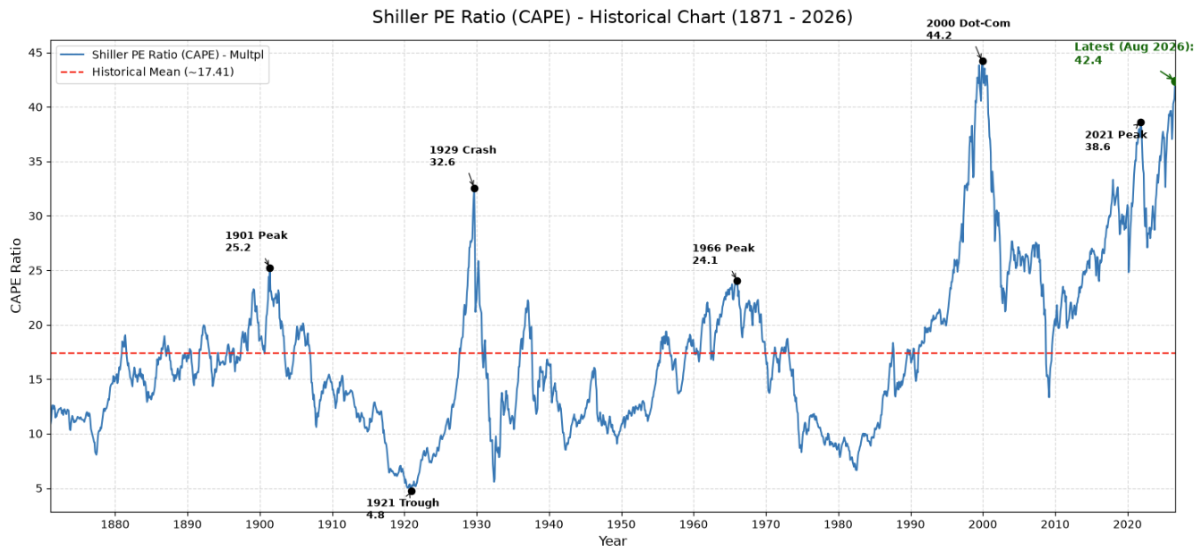
Inflation remains stubbornly above the Federal Reserve’s inflation target of 2%, and everyone is feeling the pain. The war with Iran creates an economic wildcard and growing federal deficits raise legitimate questions about our long-term fiscal position. The risk that AI exuberance is overinflating stock valuations is supported by The Shiller CAPE ratio, or Cyclically Adjusted Price-to-Earnings ratio, which currently sits around 42 compared with a long-term average of roughly 27 since 1990.
Unlike a traditional P/E ratio, which generally compares today's price with one year of earnings, CAPE uses 10 years of inflation-adjusted earnings. The goal is to smooth out economic cycles and provide a longer-term perspective on valuation. By that measure, stocks look expensive. Very expensive.
Before selling everything and moving to a cabin in the woods, however, CAPE has its limitations. It is backward-looking, accounting standards and corporate profit margins have changed, and today's S&P 500 looks very different from the market of several decades ago. Most importantly, expensive markets can remain expensive for a long time.
CAPE is useful information. It isn't a crystal ball, and it’s short-term predictive ability is poor.
The Bull Case: Plenty Going Right Too
Despite those concerns, the economy continues to show resilience. Unemployment remains low, consumers are spending, corporate earnings have been strong, and underneath all of that may be an even more important story: productivity.
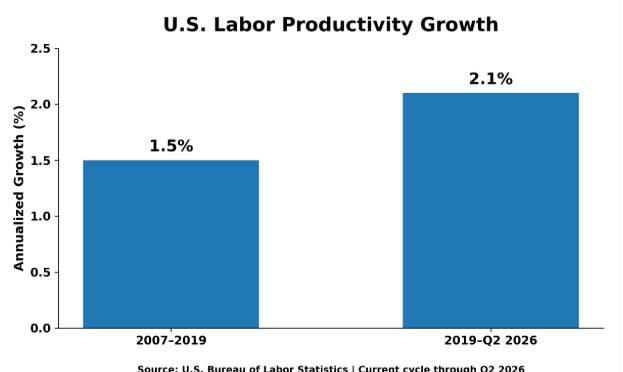
Productivity measures how much economic output we generate for each hour worked. U.S. nonfarm business productivity increased 2.2% over the past year and has grown at approximately a 2.1% annualized rate during the current business cycle, compared with 1.5% during the previous cycle.
Artificial intelligence deserves some of the attention here. Businesses are pouring enormous amounts of capital into AI, cloud computing, data centers, and automation. Whether AI changes the world quite as quickly as its biggest cheerleaders predict remains to be seen. It has already mastered writing emails nobody wanted to write, so we're making progress.
More seriously, if these investments translate into sustained productivity gains, businesses could produce more, increase profits, and potentially grow faster without generating the same inflationary pressure. That could be an important long-term tailwind for the economy.
Valuation Requires Context
This is also why no single metric should drive an investment decision. CAPE makes the overall market look expensive, while traditional P/E ratios and individual company fundamentals can paint a different picture.
Nvidia is a good example. Its traditional trailing P/E ratio is currently around 27.9 forward P/E ratio is 24, while its Shiller CAPE ratio is roughly 140. That enormous difference exists largely because CAPE averages the previous 10 years of earnings, a period during which Nvidia was a dramatically smaller and less profitable company. Which number better reflects its value today? Neither tells the whole story, which is precisely the point. The lesson isn't that stocks are cheap or expensive. It's that valuation requires context. CAPE, P/E ratios, earnings growth, interest rates, profit margins, and balance sheets all provide useful information. None provides the answer by itself.
Don't Pick a Side. Build a Plan.
So what do you do when the optimists and pessimists both make compelling arguments? You don't have to pick a side.
Through Wealth Done RITE, we focus on what we can control: maintaining appropriate risk levels, diversification, portfolio construction, opportunistic rebalancing, tax efficiency, liquidity, and continually adjusting the strategy as markets and our clients' lives change.
The optimists may be right. The pessimists may be right. More likely, they'll each be right about different things at different times.
Good planning doesn't require us to know which one will be right next. We don't invest for the world we hope for or the world we fear. We build portfolios designed for the world as it unfolds.
Investment strategies, including rebalancing, do not guarantee improved performance and involve risk, including potential loss of principal. Past performance does not guarantee future results. The information provided is for educational and informational purposes only and does not constitute investment advice and it should not be relied on as such. It should not be considered a solicitation to buy or an offer to sell a security. It does not take into account any investor's particular investment objectives, strategies, tax status or investment horizon. All information has been obtained from sources believed to be reliable, but its accuracy is not guaranteed. There is no representation or warranty as to the current accuracy, reliability or completeness of, nor liability for, decisions based on such information and it should not be relied on as such.
About the Author – Tim Macarak CFP®
Tim Macarak is President & Head of Wealth Management at Member’s Wealth, a boutique wealth management firm that offers a comprehensive approach to serving individuals, families, business owners, and institutions. The firm’s goal is to preserve and grow its clients’ wealth to endure overtime, while thoughtfully evolving its strategy to suit an ever-changing world. With over 20 years of wealth management experience, Tim and the Members' Wealth team thrive on bringing clarity and confidence to clients' unique situations. He believes everyone needs sound financial advice from someone whose interests are aligned with theirs and is determined to put service before all else.
Tim is a CERTIFIED FINANCIAL PLANNER® Professional. Outside work, he enjoys spending time with his wife and kids, Skiing, Coaching, and Traveling. To learn more about Tim, connect with him on LinkedIn.
To get in touch with the Members’ Wealth team today, I invite you to email info@memberswealthllc.com or call (267) 367-5453.
You can learn more about how we serve our clients by tapping the button below.
Investment advisory services are offered through Members’ Wealth, LLC., a Registered Investment Advisory Firm.
Registration with the SEC does not imply a certain level of skill or training. We are an independent advisory firm helping individuals achieve their financial needs and goals
Members’ Wealth does not provide legal, accounting or tax advice. Please consult your tax or legal advisors before taking any action that may have tax consequences.
This commentary reflects the personal opinions, viewpoints and analyses of the Members’ Wealth, LLC employees providing such comments, and should not be regarded as a description of advisory services provided by Members’ Wealth, LLC or performance returns of any Members’ Wealth, LLC client. The views reflected in the commentary are subject to change at any time without notice. Nothing in this commentary constitutes investment advice, performance data or any recommendation that any particular security, portfolio of securities, transaction or investment strategy is suitable for any specific person. Any mention of a particular security and related performance data is not a recommendation to buy or sell that security. Members’ Wealth, LLC manages its clients’ accounts using a variety of investment techniques and strategies, which are not necessarily discussed in the commentary. Investments in securities involve the risk of loss. Past performance is no guarantee of future results
Copyright © 2023 Members' Wealth LLC